
Cooling Tower Manufacturing
Cooling towers are manufactured in-house to the required heat-rejection duty, water flow and site conditions, with configuration matched to the application.
A cooling tower rejects heat from circulating water by transferring it to the ambient air. In a water-cooled HVAC facility, it works alongside the condenser-water system — chillers, pumps, pipelines and controls — as one connected circuit rather than a standalone box.
Sofia Cooltech Engineers manufactures and supplies cooling towers in-house, and supports the requirements around them: technical assessment, selection, manufacturing, installation, inspection, long-term maintenance and AMC. An in-house team of more than 50 engineers, technicians and site staff carries a project from specification through to years of operation.
Because manufacturing and service sit with the same team, a project doesn't get handed between a supplier and a separate maintenance contractor — one point of contact carries the tower from specification through to years of operation.
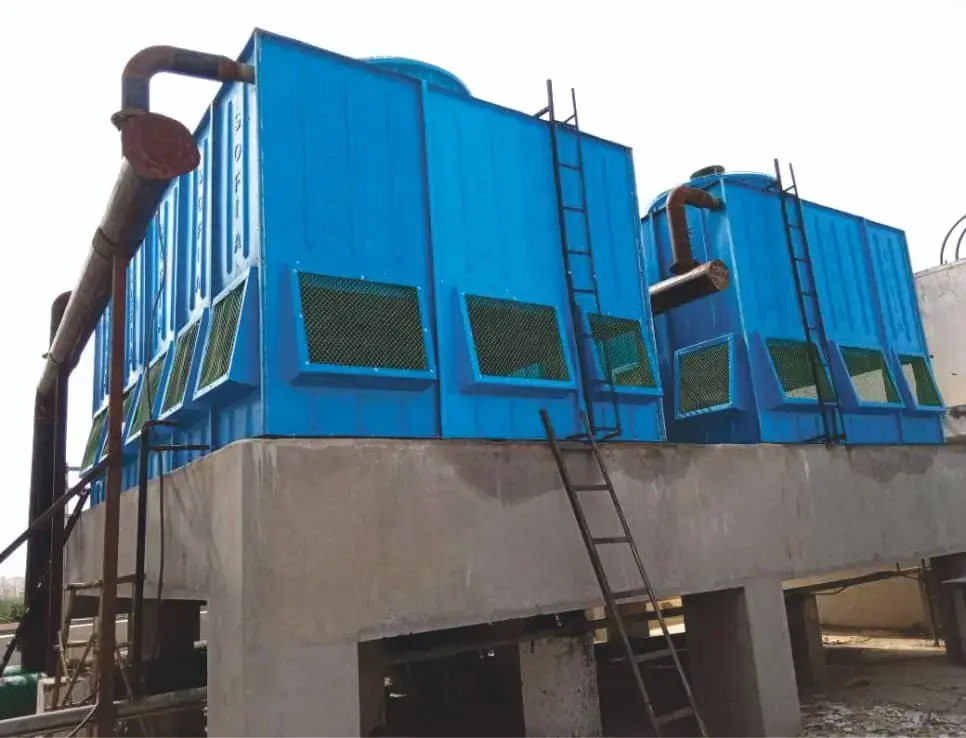
Designed and built by the same team, not sourced from a third-party OEM and resold.
Cooling tower selection isn't based on a fixed catalogue layout. Heat-rejection duty, circulating-water flow, entering and leaving water temperatures and design conditions are worked out first, and the tower is engineered around those numbers rather than the other way round.
Because manufacturing happens in-house, changes to the specification — a different fill configuration, a revised footprint, a material change for a corrosive environment — can be made during design rather than requiring a separate negotiation with an external factory.
For replacement or upgrade work, the existing tower and connected system can be reviewed first, so the new unit is built to match real operating conditions instead of a generic nameplate rating.
A cooling tower's real cost and reliability show up over years of operation, not on day one — so the scope is planned as one continuous relationship rather than a single transaction.
Duty, water flow, temperatures and site conditions are established first; the tower is then manufactured in-house to that specification, with pre-dispatch checks before it leaves the facility.
Positioning, structural support, water and electrical connections and access for future maintenance are planned before the unit arrives on site, not worked out on the day of delivery.
Installation is coordinated against the agreed scope, followed by testing and commissioning checks — airflow, water distribution, controls — before the tower is handed over for operation.
Scheduled inspection, cleaning, water-distribution and mechanical checks keep the tower performing near its design point for years — and because it was manufactured in-house, replacement components can be matched to the original specification rather than an aftermarket approximation.
Whether the requirement is new manufacturing, a replacement, installation, inspection, maintenance, or a piece of a larger HVAC project, the same team handles it end to end.
Cooling towers are manufactured in-house to the required heat-rejection duty, water flow and site conditions, with configuration matched to the application.
Review the cooling requirement, existing equipment, site constraints, access and interfaces with the connected HVAC or process system.
Coordinate tower requirements around heat-rejection duty, water flow, temperatures, airflow, space and the wider cooling circuit.
Installation coordination covers tower positioning, support arrangements, cooling-water connections, electrical interfaces, controls and commissioning.
Existing equipment is assessed for mechanical condition, airflow, water distribution, fill, basin condition and operating issues.
Planned service includes inspection, cleaning, operating checks, component attention and condition-based maintenance under an agreed AMC where required.
Configuration is worked out from the application, heat-rejection duty, airflow, site conditions and maintenance access — not chosen from a single default layout.
Considered where corrosion resistance, practical installation and long-term maintainability are important requirements.
Use fans to draw air through the tower; used across commercial and industrial cooling applications.
Air passes across the falling water through the fill; a layout choice with its own access and footprint characteristics.
Air moves opposite to falling water; used across commercial and industrial applications where this arrangement suits the site.
Heat-rejection duty, water flow, temperatures and design conditions drive the manufacturing specification, not the other way round.
Available footprint, airflow and future maintenance requirements are considered during manufacturing, not left for site teams to work around later.
Central HVAC plants and industrial systems both depend on cooling towers wherever circulating water needs to reject heat.
Cooling towers form part of water-cooled air-conditioning systems, working with chillers and condenser-water circulation.
See our HVAC engineering and contracting scopeIndustrial facilities use cooling towers for process equipment, utilities or central cooling where heat rejection is required.
Large offices, malls and similar buildings often run central chilled-water systems with cooling towers as part of the plant.
Healthcare facilities use central cooling plants to serve multiple areas with continuous operating requirements.
Hospitality facilities have varying cooling loads across guest rooms, public areas and service spaces.
Food-related facilities often combine process cooling, refrigeration and HVAC requirements within the same engineering project.
Explore refrigeration equipment for food and cold-chain useCleaning on its own isn't maintenance — a proper review covers the tower's whole functioning condition: water distribution, airflow, heat-transfer surfaces and mechanical components together, not in isolation.
Depending on condition, fans, motors, drives, fill, basin and water-distribution components may need attention. Because the tower was manufactured in-house, replacement parts can be matched to the original specification instead of relying on a generic aftermarket equivalent that may not fit or perform the same way.
Preventive service is then scheduled around equipment condition, operating environment and how the tower is actually used — under an Annual Maintenance Contract where that fits the project.
Electrical and controls coordination for fans, motors and drives
Original manufacturing specifications on file mean service work is matched to the actual unit, not guessed at.
A cooling tower is part of a larger heat-rejection circuit, so coordination covers manufacturing together with the connected equipment and site requirements — not the tower in isolation.
Review the facility, cooling duty, existing equipment, operating conditions and project objective.
Consider tower configuration, materials, installation conditions, equipment interfaces and the connected cooling system.
Manufacture the tower in-house to the agreed specification and coordinate it with pumps, piping, electrical requirements and controls.
Installation is coordinated according to the agreed scope, equipment configuration and site conditions.
Airflow, water distribution and control checks are completed before the tower is handed over for operation.
Inspection, repair and AMC support are planned around equipment condition and operating needs for the life of the tower.
Share the application, project location, existing equipment details and whether the requirement is a new tower, replacement, installation or maintenance scope.