
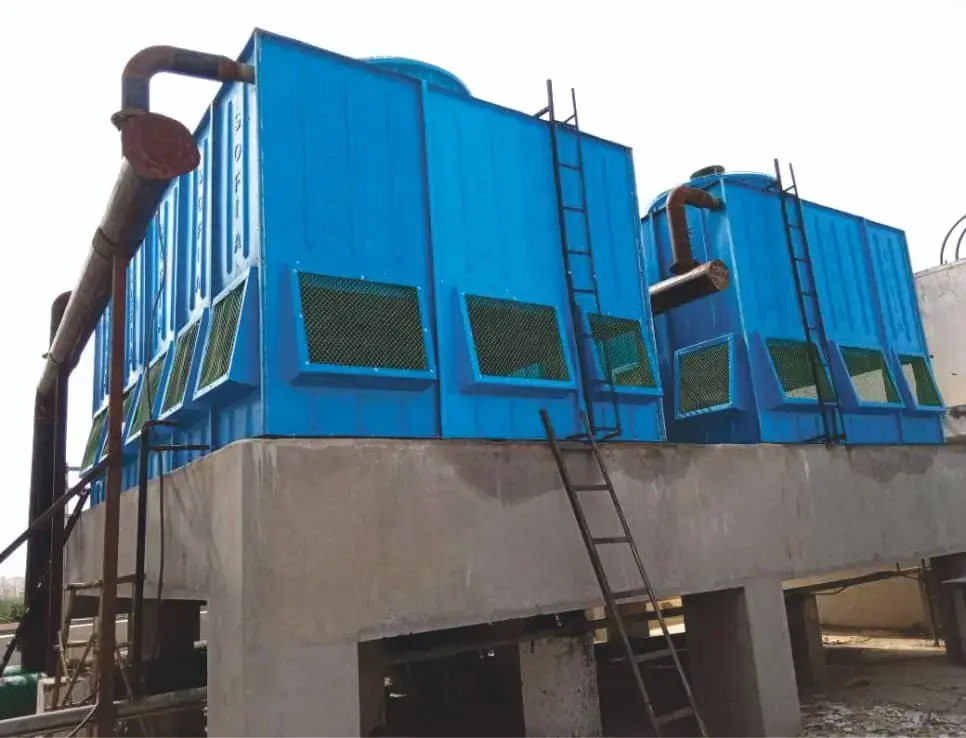
An induced-draft cooling tower installed as part of a commercial condenser-water system.
Quick Answer
A cooling tower cools the water coming out of a chiller condenser or an industrial process by exposing it to moving air — most of the cooling happens through evaporation. Which tower suits your project depends on five things: how much heat you need to reject, your required leaving-water temperature, the outdoor design wet-bulb condition at your site, available installation space, and how much maintenance access you can provide. Get these five right first; then compare counter-flow vs cross-flow, FRP vs RCC, and induced vs forced draft.
Where a Cooling Tower Fits in Your HVAC or Process System
In a typical water-cooled HVAC plant, the chiller's condenser rejects heat into a loop of circulating water. That water has to be cooled again before it goes back to the condenser — that's the tower's only job. The full loop usually includes the chiller, condenser-water pumps, piping, controls and water-treatment dosing equipment working alongside the tower, so the tower can't really be evaluated in isolation from the rest of the plant.
You'll find cooling towers on hospital and hotel HVAC plants, commercial office buildings, data centres, and manufacturing or process facilities wherever water-cooled heat rejection makes more sense than air-cooled equipment — usually because of better efficiency at scale or space constraints on air-cooled condensers.
Planning a new installation? See our cooling tower manufacturing and engineering page for the exact project inputs we ask for before quoting.
The one mistake to avoid: choosing a tower by its nameplate tonnage alone. Two towers rated at the same nominal capacity can perform very differently at your site's actual wet-bulb condition — size against your real operating numbers, not the catalogue label.
How Does a Cooling Tower Work?
Mechanically, a cooling tower brings warm circulating water into direct contact with a stream of moving air. A small fraction of that water evaporates in the process — and evaporation pulls a disproportionate amount of heat out of the water that stays liquid, which is why cooling towers are so much more compact than dry (air-cooled) equipment of the same capacity. The now-cooler water drains into the basin and heads back to the chiller or process.
Step by step
- Hot water enters: water returning from the chiller or process arrives at the tower at its entering-water temperature.
- Distribution: nozzles or a distribution deck spread the water evenly across the fill (the heat-transfer media inside the tower).
- Airflow: a fan — or, in natural-draft designs, the tower's own stack effect — pulls or pushes air through the falling water.
- Heat and mass transfer: as air and water meet across the fill, heat moves from water to air and a portion of the water evaporates.
- Collection: cooled water collects in the basin and is pumped back into the condenser-water or process loop.
Air rises straight up as water falls straight down — the two streams meet head-on.
Air moves sideways through a curtain of falling water instead of meeting it head-on.
Range and approach — the two numbers that actually define performance
Range is simply entering-water temperature minus leaving-water temperature — how many degrees the tower cools the water by. Approach is leaving-water temperature minus the outdoor wet-bulb temperature — how close the tower gets the water to the theoretical limit set by the weather. A tower can't cool water below the wet-bulb temperature, so the tighter the approach you need, the larger or more efficient the tower has to be for the same flow rate.
Worked example
Say a chiller's condenser water enters the tower at 35°C and needs to leave at 30°C — that's a 5°C range. If the site's design wet-bulb temperature is 27.8°C (typical for many North Indian summer design conditions), a leaving temperature of 30°C gives a 2.2°C approach. A 2.2°C approach is fairly tight and will need a larger or more thermally efficient tower than, say, a 4-5°C approach at the same flow rate — this is exactly the kind of number your tower supplier should be sizing against, not guessing.
Cooling Tower Types: Counter-Flow, Cross-Flow, FRP, RCC and Draft Arrangement
Towers are typically classified along three independent axes: how air and water move relative to each other, how the fan is positioned, and what the tower is built from. None of these is a "better" choice in the abstract — the right combination depends on your thermal duty, site constraints, water quality and how much maintenance access you can give it.
Counter-flow cooling tower
Water falls straight down through the fill while air is drawn straight up against it. Because the coolest water meets the driest incoming air right at the bottom, counter-flow towers tend to be thermally efficient for their footprint — a useful trait where rooftop space is tight. The trade-off is that the distribution nozzles sit above the fill and air stream, which can make them slightly less convenient to inspect than a cross-flow deck.
Cross-flow cooling tower
Water falls vertically while air passes horizontally through it. The distribution basin sits on top and is open to walk-on access in most designs, which many maintenance teams find easier to inspect and clean than a pressurised counter-flow spray system. Cross-flow towers often have a slightly larger footprint than a counter-flow tower of equal duty, so they suit sites with a bit more plan area to spare.
FRP (fibreglass-reinforced plastic) cooling tower
FRP construction resists corrosion well and is lighter than concrete, which usually means faster factory fabrication and easier crane-lifting onto a rooftop. It's the common choice for most commercial and mid-size industrial installations in India where the tower needs to be delivered as a packaged unit rather than built on site.
RCC (reinforced-concrete) cooling tower
RCC towers are cast in place as permanent civil structures, which suits very large industrial duties where the tower is effectively part of the building. They demand full civil and structural design input from day one and a longer construction timeline than a factory-built FRP unit, but can be sized well beyond what a packaged tower offers.
Induced-draft vs forced-draft
An induced-draft tower puts the fan at the air-discharge point, pulling air through — this is the more common arrangement in commercial FRP towers and generally gives better air distribution across the fill. A forced-draft tower places the fan at the air intake, pushing air in — this keeps the fan and motor out of the humid discharge air stream, which can simplify maintenance, but the incoming air distribution needs more careful design to avoid uneven cooling.
| Configuration | Best suited when | Watch out for |
|---|---|---|
| Counter-flow | Footprint is tight and you need high thermal efficiency per square metre. | Nozzle inspection needs the spray system to be shut down and drained. |
| Cross-flow | Easy walk-on access to the distribution basin matters for your maintenance team. | Needs a slightly larger footprint for the same duty. |
| Induced draft | You want consistent air distribution across the full fill area. | Fan and motor sit in humid discharge air — check corrosion protection. |
| Forced draft | You'd rather keep the fan/motor out of the moist discharge stream. | Intake air distribution needs careful design to avoid uneven cooling. |
| FRP | You need a factory-built package delivered and craned into place quickly. | Structural and lifting plan still has to suit rooftop access. |
| RCC | Duty is very large and the tower will effectively be part of the building. | Full civil/structural design and longer construction timeline. |
How to Select and Size a Cooling Tower for a Project
Sizing starts from your actual heat-rejection duty, not the tower's catalogue tonnage. Two towers with the same nominal rating can hit very different leaving-water temperatures once you factor in your site's real wet-bulb condition, so the checklist below should be worked through in order.
Cooling Tower Selection Checklist
- Heat-rejection load: the actual heat your chiller or process needs rejected, in kW or TR.
- Circulating-water flow: the design flow rate at that load, usually in m³/hr or GPM.
- Entering and leaving water temperatures: fixes your required range.
- Design wet-bulb temperature: the outdoor design condition for your specific location — don't reuse a figure from a different city.
- Required approach: how close leaving water needs to get to that wet-bulb figure.
- Water quality: hardness, suspended solids and any known fouling or corrosion history at site.
- Available footprint and height: plan dimensions plus clearances for service access.
- Structural capacity: confirm the rooftop or elevated structure can actually take the operating (wet) weight.
- Noise and discharge direction: distance to occupied windows, neighbouring buildings and any local noise limits.
- Maintenance access: real physical access to fans, motors, fill, nozzles, basin and drift eliminators — not just on paper.
Why the wet-bulb figure is non-negotiable
A tower can only ever cool water down toward the wet-bulb temperature of the incoming air, never below it. Two cities with the same dry-bulb summer temperature can have noticeably different wet-bulb design conditions depending on humidity, which changes how close an approach is realistically achievable. Always size against your project's specific location — not a rule-of-thumb figure carried over from a previous job.
| Parameter | What it locks in |
|---|---|
| Heat load and water flow | The thermal duty the tower has to handle. |
| Range | The temperature drop the tower must deliver. |
| Approach | How close leaving water must get to the outdoor wet bulb. |
| Design wet bulb | The physical limit the tower is working against. |
| Water quality | How aggressively you'll need to manage scaling, fouling and corrosion. |
| Footprint and structure | Whether the tower can physically be installed and supported. |
| Noise and discharge | Whether the installation is acceptable to occupants and neighbours. |
| Maintenance access | Whether the tower can actually be kept in good condition long-term. |
Cooling Tower Installation: What to Check Before Delivery
Picking the right tower is only half the job — installation planning needs to start before the equipment leaves the factory, so civil, piping, electrical and access work is ready the day it arrives.
- Foundation or support: confirm levels, load capacity, vibration isolation and structural sign-off in advance.
- Access route: plan how the tower gets unloaded, lifted and positioned — and how a future replacement unit would get in and out.
- Condenser-water piping: agree pipe sizes, valves, strainers, drain and overflow points, and exact connection locations.
- Electrical supply: confirm motor power, starter/VFD type, isolation switch and earthing before the fan arrives.
- Air discharge path: keep intake and discharge clear of obstructions to avoid the tower recirculating its own warm, humid exhaust.
- Service clearances: leave genuine walking/working room around fans, motors, fill, nozzles and the basin.
- Water treatment tie-in: coordinate dosing, filtration, blowdown and makeup-water points with the plant's water-treatment plan.
On multi-system projects, coordinate the tower with the broader HVAC design and installation and, where the plant has variable-speed drives or dedicated power feeds, the electrical works.
Cooling Tower Water Use, Blowdown and Treatment
Makeup water demand comes from three sources — evaporation, blowdown and drift — and the total should be calculated for your specific project rather than assumed as a flat percentage of circulation flow.
Evaporation
This is the mechanism that actually does the cooling: a small share of the circulating water changes to vapour and carries heat away with it. It's unavoidable and, in fact, is the point of an evaporative tower — the makeup water replacing it is a normal running cost, not a fault.
Blowdown
As water evaporates, the minerals it was carrying stay behind and concentrate in the remaining water. Blowdown deliberately drains off a controlled portion of that concentrated water so dissolved solids don't climb high enough to cause scaling or corrosion.
Drift
Drift is fine water droplets that escape with the discharge air rather than evaporating — pure water loss with no cooling benefit. Well-selected and well-maintained drift eliminators keep this to a small fraction of total flow.
Cycles of concentration
This is the ratio between mineral concentration in the circulating water and in the fresh makeup water. Push the cycles higher and you reduce blowdown volume and makeup demand — but only up to the point your water chemistry can tolerate before scaling, corrosion or biological growth becomes a risk, so this figure should be set jointly with whoever manages your water treatment.
Water management is part of equipment performance, not a separate line item. A correctly sized tower can still develop scaling, fouling and premature component wear if blowdown and water chemistry aren't actively managed — the equipment and the water programme succeed or fail together.
Cooling Tower Maintenance Checklist
A working preventive-maintenance routine combines mechanical inspection, cleaning, water treatment and performance checks. Follow manufacturer intervals as the baseline, then tighten them if your site's water quality or duty cycle demands it.
- Basin: check water level, debris and any visible biological growth.
- Fill: look for fouling, blockage, physical damage and uneven water distribution across it.
- Nozzles and distribution: confirm water is actually reaching every part of the fill, not just the centre.
- Fans and drives: inspect blades, bearings, belts, motors and gearboxes for wear, vibration or unusual noise.
- Drift eliminators: check for damage, displacement or gaps that let droplets escape.
- Water chemistry: monitor treatment dosing against your target scale, corrosion and biological-control limits.
- Blowdown: verify the actual blowdown rate is holding the cycles of concentration you designed for.
- Cleaning: schedule based on what inspections and water-quality trends are actually showing, not a fixed calendar alone.
Water Treatment and Legionella Risk
Warm, aerated cooling-tower water is a favourable environment for Legionella if it isn't actively managed, so control measures need to sit inside your site's broader water-safety programme — not be treated as an optional add-on. That typically means routine monitoring, biocide dosing, and periodic cleaning on a documented schedule.
Chemical treatment alone isn't enough, though — it doesn't substitute for mechanical upkeep. A basin full of debris or a damaged fill bed can undermine even a well-run water-treatment programme, so both need to run in parallel.
Cooling Tower Project Process: From Enquiry to Commissioning
Here's roughly how a project moves from a first phone call to a running tower. Exact steps vary by scope, but this is the typical sequence.
Project enquiry and requirement review
We go through the application, required heat rejection, water flow, temperatures, location and whether it's a replacement or new-build scope.
Engineering data collection
We flag whatever design information is still missing — wet-bulb condition, water quality, structural constraints, available space or service requirements.
Configuration and technical evaluation
We compare tower arrangements against thermal performance, footprint, noise, maintenance access and how it ties into the rest of your system.
Supply and site coordination
Equipment, delivery, lifting, support, piping and electrical connections get sequenced with your site team.
Installation and commissioning
Installation checks, equipment inspection, system coordination, startup and commissioning are completed and documented.
Maintenance and performance support
We set up inspection, cleaning and water-treatment requirements for ongoing operation, scoped to your equipment.
Planning a cooling tower project? You don't need every parameter finalised before reaching out — share what you have (capacity, site location, photos, water temperatures or drawings) and we'll identify what's still needed for a proper evaluation.
Send a cooling tower project enquiry to Sofia Cooltech EngineersShould You Repair, Retrofit or Replace an Existing Cooling Tower?
An older tower doesn't automatically need full replacement. The right call depends on structural and component condition, current thermal performance, water losses, energy use, spare-parts availability and the maintenance history — weighed against what the connected chiller or process actually needs going forward.
- Repair: makes sense when the tower structure is sound and the problem is isolated to a serviceable part — a motor, a section of fill, a few nozzles.
- Retrofit: worth considering when specific components (fill, drift eliminators, controls) can be upgraded to fix a recurring performance or reliability issue without replacing the whole tower.
- Replacement: the right call when the structure itself is no longer sound, the tower can't consistently hit its required leaving-water temperature, or it no longer matches the load of the connected chiller/process.
Treat replacement as a system-level decision, not a like-for-like swap. It's worth checking whether the existing chillers, condenser-water pumps, piping, electrical supply, controls and structural support still match a new tower's requirements before finalising anything.
Cooling Tower Manufacturing, Supply and Project Support in Jaipur
Sofia Cooltech Engineers is a Jaipur-based HVAC and MEP engineering company. For commercial and industrial projects across Rajasthan, cooling-tower requirements are evaluated as part of the wider mechanical and building-services scope rather than as a standalone equipment purchase.
Depending on the project, our technical review covers heat-rejection load, water flow, entering/leaving temperatures, your site's design wet-bulb condition, required approach, water quality, footprint, structural loading, noise limits, discharge path, electrical requirements and long-term maintenance access.
We handle applicable cooling-tower manufacturing, supply, installation, commissioning and maintenance support — exact scope is confirmed during technical enquiry, since every plant is a little different.
What to share for a quotation or technical review
- Required cooling or heat-rejection capacity
- Water flow rate, if available
- Entering and leaving water temperatures
- Project location (for the correct design wet-bulb condition)
- Available installation area and height restrictions
- Rooftop or ground installation details
- Water-quality information, if available
- Existing tower and chiller information, for replacement projects
- Drawings, photographs or equipment schedules, if you have them
- Required installation, commissioning or maintenance scope
On multi-system projects, we also coordinate HVAC engineering, electrical works and fire protection systems where they fall under the same scope.
Key Takeaways
The right cooling tower is the one matched to your actual thermal duty, water conditions, site wet-bulb condition and maintenance capacity — not the one with the biggest nameplate number. Counter-flow, cross-flow, induced-draft, forced-draft, FRP and RCC configurations each carry different trade-offs in footprint, access and construction time.
Selection is only the starting point. Getting reliable long-term operation also takes coordinated planning for structure, piping, electrical supply, water treatment, access and preventive maintenance — this matters just as much on a replacement project as it does on a new plant.
Planning a New Cooling Tower or Replacing an Existing Unit?
Share your load, water conditions and installation requirements for a project-specific technical review from our Jaipur engineering team.
FAQs About Cooling Towers
Straight answers to the questions we get asked most often on cooling-tower enquiries.
What does a cooling tower do?
It pulls heat out of the water circulating in a chiller's condenser loop or an industrial process loop and releases it to the atmosphere, mainly through evaporation, so the water can return cooler and absorb heat again.
How does a cooling tower work?
Warm water is sprayed over fill media while a fan (or natural draft) pulls or pushes air through it. Some of the water evaporates in that contact, which removes heat from the rest and cools it before it drains back to the basin.
What is the difference between counter-flow and cross-flow cooling towers?
Counter-flow towers move air straight up against water falling straight down; cross-flow towers move air sideways through a falling curtain of water. Counter-flow tends to be more compact for the same duty; cross-flow usually gives easier walk-on access for cleaning.
What are range and approach in cooling tower design?
Range is how many degrees the water cools between entering and leaving the tower. Approach is how close the leaving water gets to the outdoor wet-bulb temperature — the tighter the approach needed, the larger the tower has to be.
How do you select the right size cooling tower for an HVAC project?
Start from the real heat-rejection load and water flow, fix your entering/leaving temperatures against the site's design wet-bulb condition, then compare configurations, footprint, structure, noise and maintenance access — never rely on nominal tonnage alone.
How much water does a cooling tower consume?
Water is lost to evaporation, blowdown and drift. The actual volume depends on heat load, operating range, how many cycles of concentration your water chemistry can tolerate, and how well the drift eliminators are maintained — it's calculated per project, not assumed as a flat percentage.
What routine maintenance does a cooling tower need?
Basin and fill inspection, checking nozzles for even distribution, inspecting fans and drives, checking drift eliminators, monitoring water chemistry, and scheduled cleaning based on inspection results and manufacturer intervals.
Can Sofia Cooltech supply and install a cooling tower in Jaipur or Rajasthan?
Yes — we're based in Jaipur and handle cooling-tower manufacturing, supply, installation, commissioning and maintenance support for commercial and industrial projects across Rajasthan, with scope confirmed during technical review.
Can an existing cooling tower be replaced or retrofitted instead of buying new?
Often yes. If the structure and major components are sound, retrofitting fill, fans, drift eliminators or controls can restore performance at lower cost than full replacement. Full replacement is usually only needed when the structure is unsuitable or performance keeps falling short.
What details should I share to get a cooling tower quotation?
Required heat-rejection capacity or chiller tonnage, water flow rate if known, entering/leaving temperatures, project location, available installation area, and — for replacements — photos or the nameplate details of the existing tower.
Technical References
Cooling-tower sizing and project design should always be checked against the applicable project specification, manufacturer documentation and relevant engineering standards.
- ASHRAE guidance on cooling tower thermal performance, range, approach and design conditions.
- Cooling Technology Institute (CTI) standards and acceptance test guidance, where applicable to the project.
- Cooling-tower manufacturer technical data sheets, installation instructions and maintenance manuals for the specific unit installed.
- Project-specific HVAC, process, structural, electrical and water-treatment design requirements.
Related HVAC and MEP Services
Cooling Tower Manufacturing & Supply
Manufacturing, supply, installation, commissioning and maintenance support for cooling towers.
HVAC Design & Installation
Commercial and industrial HVAC engineering, supply and installation.
Fire Fighting & Protection Systems
Fire protection engineering and installation for commercial and industrial projects.
More HVAC & MEP Guides
Practical engineering guides covering HVAC, MEP, cooling towers and related topics.