
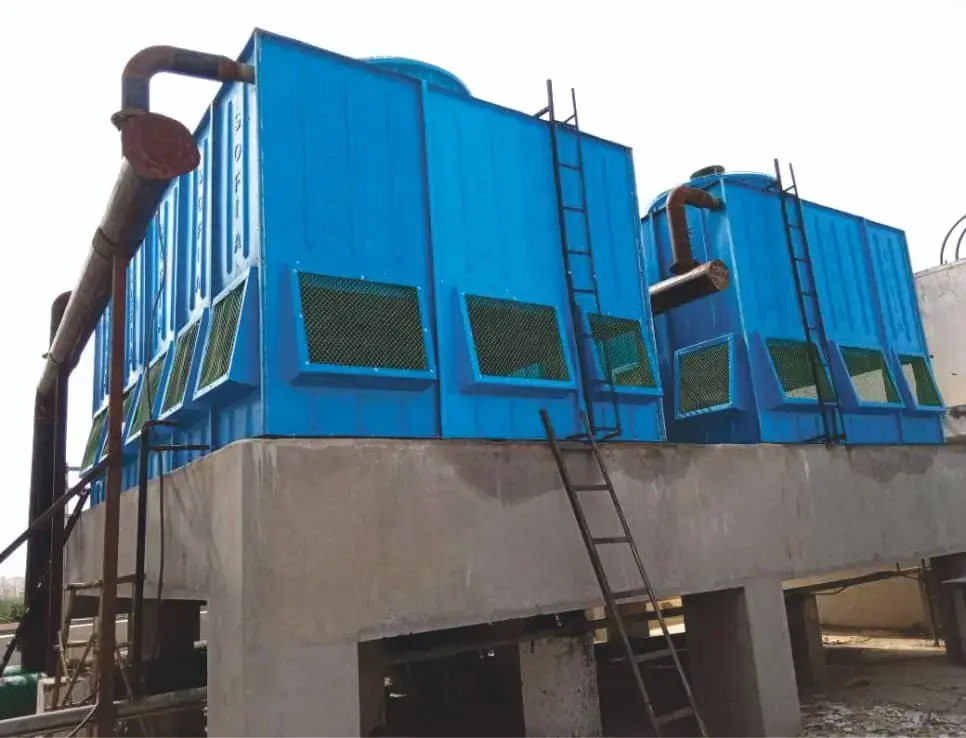
What Is a Cooling Tower?
A cooling tower is a heat-rejection device that removes heat from circulating water by transferring heat and moisture to an air stream. It is commonly used with water-cooled chillers and industrial process-cooling systems. Project selection depends on heat-rejection load, water flow, entering and leaving water temperatures, design wet-bulb condition, approach, water quality, installation space and maintenance requirements.
Cooling Tower Basics for HVAC and Industrial Applications
A cooling tower removes unwanted heat from water that has absorbed heat from a chiller condenser circuit, industrial process, heat exchanger or other water-cooled equipment. The tower then rejects that heat to the surrounding air. In a typical HVAC plant, it forms part of a condenser-water system that also includes chillers, pumps, piping, controls and water-treatment equipment.
Cooling towers are used in commercial buildings, hospitals, hotels, manufacturing facilities, process plants and other installations where water-cooled heat rejection is appropriate. The equipment can be compact for smaller duties or become a major mechanical and structural component in larger projects.
For a commercial requirement, see our cooling tower manufacturing and engineering services for the project information normally required before a project-specific recommendation.
Important: A cooling tower should not be selected only by nominal tonnage. Thermal duty and site design conditions determine whether a tower can achieve the required leaving-water temperature.
How Does a Cooling Tower Work?
A mechanical cooling tower brings circulating water into contact with moving air. A portion of the water evaporates, carrying heat away from the remaining water. The cooled water is collected and returned to the chiller or process circuit. Actual thermal performance depends on water flow, air conditions, tower configuration and the required range and approach.
The cooling-tower cycle in practical terms
- Hot water enters: Water returning from the chiller or process enters at the specified entering-water temperature.
- Water is distributed: Nozzles or another distribution system spreads water over the fill or heat-transfer area.
- Air moves through the tower: A fan-driven or natural-draft arrangement moves air through the water stream.
- Heat and mass transfer occur: Air-water contact enables heat transfer, with evaporation providing an important part of the cooling effect.
- Cooled water is collected: Water falls into the basin and returns to the condenser-water or process loop.
What are cooling tower range and approach?
Range is the difference between entering hot-water temperature and leaving cold-water temperature. Approach is the difference between leaving-water temperature and entering-air wet-bulb temperature. A smaller approach generally demands greater thermal capability and should be evaluated against the project's design condition.
Cooling Tower Types: Counter-Flow, Cross-Flow, FRP and More
Cooling towers can be classified by air and water movement, fan arrangement and construction material. No single configuration is automatically right for every project. Selection should reflect thermal duty, site constraints, maintenance access, water quality, structural requirements and operating conditions.
Counter-flow cooling tower
In a counter-flow tower, water travels downward while air moves upward. The opposing flow arrangement can provide effective heat transfer, but airflow, water distribution, maintenance and discharge conditions still need project-specific evaluation.
Cross-flow cooling tower
In a cross-flow tower, air moves horizontally across water falling through the fill. The arrangement can influence plant layout and access to distribution components depending on the equipment design.
FRP cooling tower
FRP, or fibreglass-reinforced plastic, construction is considered where corrosion resistance, weight, fabrication and installation conditions are relevant. Thermal duty and structural suitability still need to be verified for the actual site.
RCC cooling tower
RCC, or reinforced-concrete, towers are permanent civil structures and may suit large installations designed around a concrete tower. Civil, structural, construction and maintenance planning become important parts of the solution.
Induced-draft vs forced-draft cooling tower
An induced-draft tower normally places the fan at the discharge side to pull air through the tower. A forced-draft tower places the fan at the air-intake side to push air through the tower. Fan position can affect airflow, discharge, noise, maintenance and installation conditions.
| Configuration | How it works | Project consideration |
|---|---|---|
| Counter-flow | Air and water move in opposite directions. | Thermal performance, footprint and maintenance access. |
| Cross-flow | Air moves across falling water. | Layout, distribution access and airflow arrangement. |
| Induced draft | Fan pulls air through the tower. | Discharge, drift, noise and fan maintenance. |
| Forced draft | Fan pushes air through the tower. | Air distribution, intake conditions and noise. |
| FRP | Factory-built FRP construction. | Corrosion, structural suitability and application. |
| RCC | Permanent reinforced-concrete structure. | Civil, structural and long-term maintenance planning. |
How to Select and Size a Cooling Tower for a Project
Cooling-tower selection starts with the actual heat-rejection requirement and project operating conditions. A catalogue capacity or nominal tonnage figure alone does not establish whether the equipment will achieve the required leaving-water temperature.
Cooling Tower Selection Checklist
- Heat-rejection load: Establish the heat to be rejected from the chiller or process.
- Circulating-water flow: Confirm the required water flow at the design condition.
- Entering and leaving water temperatures: Define operating temperatures and range.
- Design wet-bulb temperature: Use the applicable project design condition for the installation location.
- Required approach: Establish the required leaving-water temperature relative to design wet bulb.
- Water quality: Review hardness, suspended solids, fouling, corrosion and biological-control requirements.
- Available footprint: Confirm dimensions and service clearances.
- Structural capacity: Confirm rooftop or elevated loads with the project structural design.
- Noise and discharge: Review occupied areas, nearby buildings, discharge direction and drift.
- Maintenance access: Provide practical access to fans, motors, fill, nozzles, basin and drift eliminators.
Why local design conditions matter
Entering-air wet-bulb condition has a direct relationship with cooling-tower thermal performance. The same equipment can behave differently under different outdoor design conditions, so selection should use the project's specified design condition rather than a generic assumption.
| Parameter | Why it matters |
|---|---|
| Heat load and water flow | Defines the thermal duty the tower must handle. |
| Range | Defines the required water-temperature reduction. |
| Approach | Defines how close leaving water must be to entering-air wet bulb. |
| Design wet bulb | Represents the relevant outdoor design condition. |
| Water quality | Influences scaling, fouling, corrosion and biological control. |
| Footprint and structure | Determines whether equipment can be installed safely. |
| Noise and discharge | Important near occupied areas and neighbouring properties. |
| Maintenance access | Supports safe inspection and long-term serviceability. |
Cooling Tower Installation: What Should Be Checked Before Delivery?
Equipment selection is only one part of a successful cooling-tower project. Installation planning should begin before delivery so civil, structural, piping, electrical and access requirements are coordinated.
- Foundation or support: Verify dimensions, levels, loads, vibration considerations and structural suitability.
- Equipment access: Confirm unloading, lifting, positioning and future replacement routes.
- Condenser-water piping: Coordinate pipe sizes, valves, strainers, drains, overflow and connection locations.
- Electrical supply: Confirm motor power, starters or drives, isolation, earthing and control requirements.
- Air discharge: Check intake and discharge clearances to reduce recirculation and obstructions.
- Service clearances: Maintain access around fans, motors, fill, nozzles, basin and treatment equipment.
- Water treatment: Coordinate filtration, dosing, blowdown, makeup water and monitoring requirements.
For projects involving several building systems, coordinate the tower with the wider HVAC engineering and installation scope and, where applicable, electrical engineering requirements.
Cooling Tower Water Consumption, Blowdown and Water Treatment
Cooling-tower makeup-water demand is generally associated with evaporation, blowdown and drift. Actual quantity depends on thermal load, operating range, water flow, cycles of concentration, drift performance and the site's water-management strategy. It should be calculated for the project rather than expressed as one universal percentage.
Evaporation
Evaporation is a fundamental part of evaporative cooling. As a portion of the water changes into vapour, heat is transferred from circulating water into the air stream and the loss is replaced with makeup water.
Blowdown
Evaporation concentrates dissolved minerals and other non-volatile substances in circulating water. Blowdown removes a controlled portion so chemistry remains within the required operating range.
Drift
Drift consists of small water droplets carried out with discharge air. Properly selected and maintained drift eliminators help minimise this loss.
Cycles of concentration
Cycles of concentration describe the relationship between dissolved-substance concentration in circulating water and makeup water. Higher cycles can reduce blowdown and makeup-water demand, but water chemistry must remain controlled to limit scaling, corrosion and biological growth.
Water management is part of equipment performance. A correctly selected tower can still experience avoidable performance and maintenance problems if water chemistry, cleaning and blowdown are poorly managed.
Cooling Tower Maintenance Checklist for Reliable Operation
Preventive maintenance should combine mechanical inspection, cleaning, water treatment and performance monitoring. Intervals should follow manufacturer instructions, operating conditions and the site's maintenance and water-management programme.
- Basin inspection: Check water level, debris, cleanliness and visible biological growth.
- Fill inspection: Look for fouling, blockage, damage and poor water distribution.
- Nozzles and distribution: Confirm that water reaches intended areas of the tower.
- Fans and drives: Inspect blades, bearings, belts, motors, gearboxes and related components as applicable.
- Drift eliminators: Check for damage, displacement and excessive water carryover.
- Water chemistry: Monitor treatment for scale, corrosion and biological control.
- Blowdown: Confirm that the strategy supports target chemistry and operating cycles.
- Cleaning: Clean when inspection results, water quality and site conditions indicate it is required.
Cooling Tower Water Treatment and Legionella Risk
Cooling-tower water systems can support Legionella growth when poorly managed. Risk control should therefore be part of the site's broader water-management programme, including appropriate monitoring, cleaning, treatment and control procedures.
Water treatment does not replace mechanical maintenance. Basin condition, fill, distribution, drift eliminators, fans and other components still require appropriate inspection and service.
Cooling Tower Project Process: From Enquiry to Commissioning
A project-specific requirement is easier to evaluate when the technical scope is clear from the beginning. A typical workflow can include the following stages; the exact scope depends on the project.
Project enquiry and requirement review
Review application, required heat rejection, water flow, temperatures, project location, installation conditions and replacement or new-build scope.
Engineering data collection
Identify missing design information such as wet-bulb condition, water quality, structural constraints, available space and service requirements.
Configuration and technical evaluation
Evaluate tower arrangement and implications for thermal performance, footprint, noise, maintenance and system integration.
Supply and site coordination
Coordinate equipment, delivery, lifting, support, piping, electrical connections and installation sequencing as required.
Installation and commissioning
Complete applicable installation checks, equipment inspection, system coordination, startup and commissioning activities.
Maintenance and performance support
Establish inspection, cleaning, water-treatment and service requirements for ongoing operation, subject to equipment and project scope.
Planning a cooling tower project? You do not need every parameter ready before making an enquiry. Share available equipment details, capacity, site location, photographs, water temperatures or drawings, and the engineering team can identify additional information needed for evaluation.
Send a cooling tower project enquiry to Sofia Cooltech EngineersShould You Repair, Retrofit or Replace an Existing Cooling Tower?
An ageing cooling tower does not automatically need complete replacement. The decision should consider structural and component condition, thermal performance, water losses, energy use, spare-parts availability, maintenance history and the requirements of the connected HVAC or process system.
- Repair: Consider when the main equipment remains suitable and the problem is localised to serviceable components.
- Retrofit: Consider when selected components can be upgraded to address performance, reliability, water management or controls.
- Replacement: Consider when the tower is structurally unsuitable, repeatedly fails to meet required performance, or no longer fits the connected system.
Replacement should be checked as a system-level project rather than treated as a simple like-for-like purchase. Existing chillers, condenser-water pumps, piping, electrical systems, controls and structural support may need review.
Cooling Tower Manufacturing, Supply and Project Support
Sofia Cooltech Engineers is a Jaipur-based HVAC and MEP engineering company. For applicable commercial and industrial projects, cooling-tower requirements can be evaluated as part of the wider mechanical and building-services system.
Depending on project scope, the review may consider heat-rejection load, water flow, entering and leaving water temperatures, design wet-bulb condition, required approach, water quality, footprint, structural requirements, noise, discharge, electrical requirements and maintenance access.
The company provides applicable cooling-tower manufacturing, supply, installation, commissioning and maintenance support. Exact scope is project-dependent and should be confirmed during technical enquiry.
Information to share for a cooling-tower quotation or technical review
- Required cooling or heat-rejection capacity
- Water flow rate, if available
- Entering and leaving water temperatures
- Project location and design conditions
- Available installation area and height restrictions
- Rooftop or ground installation details
- Water-quality information, if available
- Existing tower and chiller information for replacement projects
- Drawings, photographs or equipment schedules, if available
- Required installation, commissioning or maintenance scope
If the project includes multiple building systems, related HVAC engineering services, electrical engineering services and fire protection services can be coordinated where they form part of the same project scope.
Key Takeaways for Cooling Tower Selection
The appropriate cooling tower is the one that matches the project's thermal duty, water conditions, air conditions, installation environment and operating strategy. Counter-flow, cross-flow, induced-draft, forced-draft, FRP and RCC configurations each have different engineering implications.
For dependable operation, selection should be followed by coordinated planning for structure, piping, electrical supply, water treatment, access, commissioning and preventive maintenance. This system-level approach is especially important when adding a tower to a new HVAC plant or replacing an existing unit.
Planning a New Cooling Tower or Replacing an Existing Unit?
Share your available load, water conditions, installation requirements and project details for a project-specific technical review.
FAQs About Cooling Towers
Clear answers to common questions about cooling-tower selection, installation, water management and maintenance.
What does a cooling tower do?
A cooling tower rejects heat from circulating water by transferring heat and moisture to an air stream. It is commonly connected to a chiller condenser-water circuit or an industrial process loop.
How does a cooling tower work?
Hot water is distributed through the tower while air passes through it. Heat and mass transfer occur between water and air, with evaporation providing an important part of the cooling effect.
What is the difference between counter-flow and cross-flow cooling towers?
Counter-flow towers move air and water in opposite directions, while cross-flow towers move air across falling water. Selection depends on thermal duty, footprint, access, airflow and project requirements.
What are range and approach in cooling tower design?
Range is the difference between entering hot-water and leaving cold-water temperature. Approach is the difference between leaving-water temperature and entering-air wet-bulb temperature.
How do you select a cooling tower for an HVAC project?
Start with heat-rejection load, water flow, entering and leaving water temperatures, design wet-bulb condition and required approach. Then evaluate water quality, footprint, structure, noise, discharge, maintenance access and system integration.
How much water does a cooling tower use?
Makeup water is mainly associated with evaporation, blowdown and drift. Actual demand varies with heat load, operating range, water quality, cycles of concentration, drift performance and the site's water-management strategy.
What maintenance does a cooling tower need?
Maintenance can include basin and fill inspection, nozzle and distribution checks, fan and drive inspection, drift-eliminator checks, cleaning, water-treatment monitoring and performance checks according to the manufacturer and site plan.
Can Sofia Cooltech supply and install a cooling tower?
Sofia Cooltech Engineers provides applicable cooling-tower manufacturing, supply, installation, commissioning and maintenance support. Exact scope depends on project requirements and should be confirmed during technical enquiry.
Can Sofia Cooltech help with an existing cooling tower replacement?
Yes. An existing tower can be reviewed as a replacement or retrofit requirement. Useful information includes existing tower and chiller details, operating temperatures, water flow, photographs, available space and known performance or maintenance issues.
What information should I provide to request a cooling tower quotation?
Share required heat-rejection capacity, water flow if known, entering and leaving water temperatures, project location, installation area, existing equipment information and required supply or installation scope. Drawings and photographs can also help identify missing information.
Technical References and Engineering Checks
Cooling-tower performance and project design should be checked against the applicable project specification, manufacturer documentation and relevant engineering guidance.
- ASHRAE guidance relevant to cooling towers, thermal performance, range, approach and design conditions.
- Applicable Cooling Technology Institute (CTI) standards and guidance where relevant to the project.
- Cooling-tower manufacturer technical data, installation instructions and maintenance requirements.
- Project-specific HVAC, process, structural, electrical and water-treatment requirements.
Related HVAC and MEP Services
Cooling Tower Manufacturing & Supply
Cooling-tower manufacturing, supply, installation, commissioning and maintenance support for applicable projects.
HVAC Engineering & Installation Services
Commercial and industrial HVAC engineering, supply and installation support.
Fire Fighting & Fire Protection Systems
Fire protection engineering and installation support for applicable projects.
More HVAC & MEP Engineering Articles
Explore practical guides covering HVAC, MEP, cooling towers and related engineering topics.